Some political moments don’t arrive through laws, speeches, or official announcements. They arrive through imagery, a single visual that stops people mid-scroll and forces a second look.
That was the case after an image portraying Trump as Acting President of Venezuela began circulating online. Shared on Donald Trump’s Truth Social account, the digitally altered image appeared to show the former U.S. president presenting himself as Venezuela’s “acting president.” Within hours, the image had spread beyond its original platform, triggering confusion, criticism, and intense debate across social media and international news outlets.
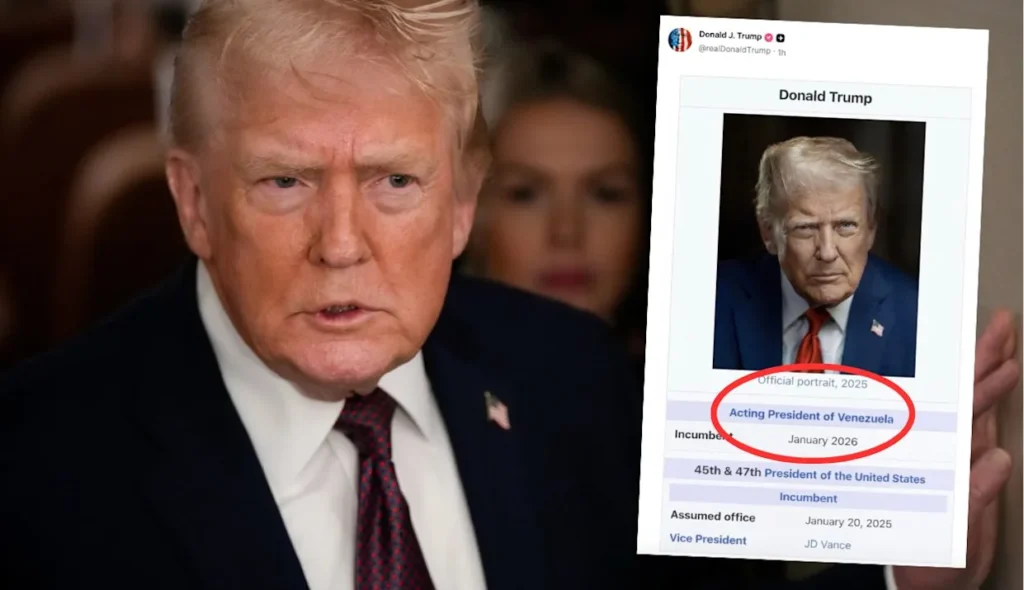
For many viewers, the moment felt jarring. The post was not accompanied by a formal explanation or political declaration, yet its symbolism was impossible to ignore. In a digital landscape where images often travel faster than context, the portrayal of Trump as Acting President of Venezuela immediately raised questions about intent, interpretation, and responsibility.
The image itself appeared stylised rather than literal, but its timing and subject matter carried weight. Venezuela’s ongoing political crisis remains highly sensitive, and any visual implication of leadership, even symbolic, has the power to reopen unresolved global tensions.
Trump as Acting President of Venezuela Appears on Truth Social
The image showing Trump as Acting President of Venezuela was shared via Truth Social, the social media platform owned by Donald Trump. In the post, Trump is depicted assuming a role tied directly to Venezuela’s contested leadership landscape.
While no caption or statement clarified the intent behind the image, observers quickly linked it to past U.S. involvement in Venezuela’s political crisis. During Trump’s presidency, the United States openly rejected Nicolás Maduro’s leadership and recognised opposition figure Juan Guaidó as Venezuela’s interim president following disputed elections.
Seen through that lens, the image portraying Trump as Acting President of Venezuela appeared to reference, or revive, a period of aggressive U.S. positioning in Venezuelan affairs.
What the Image of Trump as Acting President of Venezuela Suggests
The portrayal of Trump as Acting President of Venezuela taps into a long and complex geopolitical history.
Venezuela has spent years navigating political instability, economic collapse, international sanctions, and competing claims to leadership. Any symbolic reference to presidential authority, particularly by a former U.S. leader, carries meaning beyond satire.
Some observers interpreted the image as political provocation or rhetorical bravado. Others viewed it as misleading imagery that risks oversimplifying or trivialising a serious humanitarian and political crisis. Regardless of interpretation, the image positioned Trump as Acting President of Venezuela within a narrative that remains unresolved and deeply contested.
Public Reaction to Trump as Acting President of Venezuela
Reaction to the image of Trump as Acting President of Venezuela was swift and sharply divided.
Supporters framed the post as satire or symbolic commentary, arguing that it highlighted past U.S. opposition to authoritarian leadership in Venezuela. Critics, however, accused Trump of exploiting a fragile situation for attention, warning that such imagery could spread confusion or misinformation.
International commentators also weighed in, noting that politically altered images. especially when shared by high-profile figures, can easily be misinterpreted across borders where historical context may not be immediately clear.
Concerns Over Political Imagery and Digital Manipulation
One of the central issues raised by the image of Trump as Acting President of Venezuela is the growing role of digital manipulation in political communication.
In an era driven by speed and engagement, visuals often reach audiences before explanations do. Even when symbolic, altered images can blur the line between commentary and false representation, particularly when leadership and sovereignty are involved.
The reaction to Trump as Acting President of Venezuela has added momentum to broader conversations about ethical political messaging, digital responsibility, and the impact of imagery in shaping public perception.
Truth Social and the Reach of Political Symbolism
Truth Social has become a primary channel for Trump’s public communication, especially as his relationship with other major platforms has fluctuated over time.
The rapid spread of the image portraying Trump as Acting President of Venezuela demonstrates how content shared on the platform can quickly enter global discourse, even without traditional media framing.
Unlike speeches or official statements, social media posts often leave room for interpretation, a factor that amplifies both engagement and controversy.
Why Trump as Acting President of Venezuela Matters Beyond the Image
At its core, the portrayal of Trump as Acting President of Venezuela is not just about one image.
It reflects:
- The growing influence of visuals in political storytelling
- The sensitivity surrounding Venezuela’s leadership crisis
- The continued global impact of former political leaders
- The challenges of interpreting intent in digital communication
For many observers, the incident highlights how political influence today often operates through symbolism rather than policy alone.
Venezuela’s Political Context and Global Sensitivity
Venezuela’s political crisis has been shaped by disputed elections, economic hardship, international pressure, and humanitarian concerns.
Against this backdrop, any reference to leadership, especially one involving a foreign political figure, carries emotional and political weight. This is why the depiction of Trump as Acting President of Venezuela resonated far beyond social media timelines.
For Venezuelans and international stakeholders alike, leadership claims are not abstract ideas; they are lived realities.
A Reminder of the Power and Risk of Political Imagery
The response to Trump as Acting President of Venezuela underscores a central truth of modern politics: imagery is never neutral.
In a digital ecosystem driven by attention, symbolism can eclipse nuance. What appears obvious to one audience may be deeply misleading to another, especially when shared without context.
As political figures continue to rely on direct-to-audience platforms, moments like this reinforce the need for media literacy, careful interpretation, and responsible sharing.
Conclusion
The image portraying Trump as Acting President of Venezuela sparked global discussion not because it announced a policy change, but because it demonstrated the power of political imagery in the digital age.
Whether interpreted as satire, provocation, or symbolic commentary, the post highlights how quickly visuals can shape narratives, influence perception, and ignite controversy.
In a world where images often move faster than facts, the responsibility attached to political communication has never been greater.
Enjoyed This Story?
If you found this update on Trump as Acting President of Venezuela insightful, don’t forget to like, share, and leave a comment with your thoughts.
Follow our blog for verified global news, political developments, and in-depth analysis that goes beyond the headlines.
You can also connect with us on Instagram, Facebook, X (Twitter), and LinkedIn for timely updates, context-driven reporting, and stories that matter.
🔥Trending Nowstuff.