No products in the cart.

Best Long-Lasting Perfumes for Women (2026): Smell Good All Day Without Reapplying
Looking for perfumes that actually last all day? Here are the best long lasting perfumes…






There’s a certain kind of economic news that doesn’t announce itself with drama or spectacle. It doesn’t trend for hours or dominate group chats. Instead, it sits quietly in the background, waiting for people who understand context to realise just how much it matters.
South Africa’s decision to back and roll out the South Africa $8bn Afreximbank programme is exactly that kind of moment.
At first glance, it sounds technical. Another multilateral agreement. Another billion-dollar figure attached to trade and development. But when you pause and look closer, it becomes clear that this is not just about funding, it’s about direction. About how South Africa sees its role on the continent. About how trade, industrialisation, and African cooperation are being reshaped in real time.
The South Africa $8bn Afreximbank programme represents a deliberate shift toward deeper continental engagement, at a time when global trade is fragmenting and African economies are being pushed to rely more on one another. And while the announcement may not feel dramatic, its implications are anything but small.
The South Africa $8bn Afreximbank programme was unveiled following South Africa’s formal accession to the African Export-Import Bank (Afreximbank), making the country one of the latest African nations to fully integrate into the bank’s trade-focused development framework.
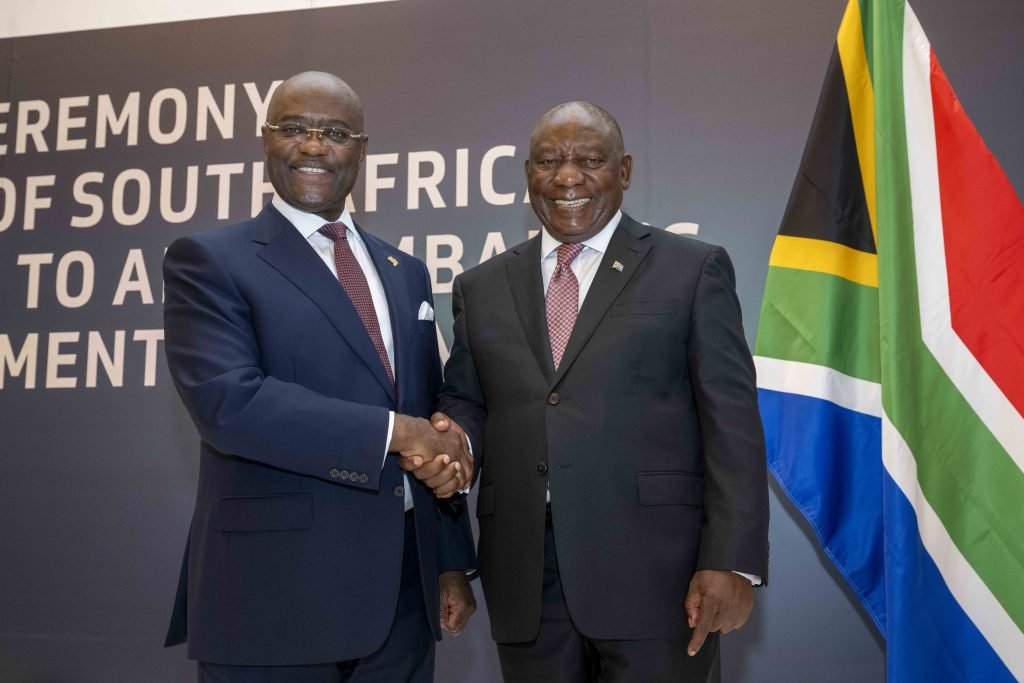
Afreximbank itself was established to support intra-African trade, industrial development, and export expansion, goals that align closely with South Africa’s long-standing economic ambitions.
According to reports, the $8 billion programme will support:
Details of the announcement can be found here
Rather than a single cash injection, the South Africa $8bn Afreximbank programme is structured as a multi-year financing and support framework, designed to unlock growth across several strategic sectors.
Timing matters in economic policy, and the timing of the South Africa $8bn Afreximbank programme is especially important.
South Africa’s economy has faced persistent challenges, slow growth, unemployment, energy constraints, and pressure on public finances. At the same time, global trade patterns are shifting, with supply chains becoming shorter and regions increasingly trading within themselves.
Against that backdrop, the South Africa $8bn Afreximbank programme signals a recognition that future growth cannot depend solely on traditional global partners. Instead, Africa itself must become a stronger internal market, and South Africa wants to be central to that process.
By aligning with Afreximbank, South Africa gains access not just to funding, but to:
This is where the programme moves from abstract policy to strategic positioning.
The phrase “trade growth” is often used loosely, but within the South Africa $8bn Afreximbank programme, it has a very specific meaning.
South Africa is already one of Africa’s largest exporters, but much of its trade has historically been outward-facing, focused on Europe, Asia, and the Americas. What Afreximbank offers is a pathway to strengthen trade within Africa itself.
Intra-African trade remains relatively low compared to other regions. The South Africa $8bn Afreximbank programme aims to change that by:
More on Afreximbank’s trade mandate can be found here
This isn’t just about moving goods, it’s about building systems that make African trade easier, cheaper, and more resilient.
One of the most significant aspects of the South Africa $8bn Afreximbank programme is its focus on industrialisation.
Rather than simply financing trade, the programme prioritises industries that can:
Manufacturing, agro-processing, mining beneficiation, and energy-linked industries are expected to be key beneficiaries. This aligns closely with South Africa’s long-term development plans, including its National Development Plan and industrial policy frameworks.
In practical terms, this means the South Africa $8bn Afreximbank programme is not just about exporting more, it’s about exporting smarter.
The South Africa $8bn Afreximbank programme also ties directly into the African Continental Free Trade Area (AfCFTA), one of the continent’s most ambitious economic projects.
AfCFTA aims to create a single African market for goods and services. But trade agreements alone don’t move goods, financing, infrastructure, and industrial capacity do. Afreximbank has positioned itself as a key financial engine behind AfCFTA, and South Africa’s participation strengthens that effort.
By joining Afreximbank and launching the South Africa $8bn Afreximbank programme, South Africa is effectively investing in the success of AfCFTA, not just rhetorically, but financially.
While the programme supports continental goals, it also offers direct benefits to South Africa.
Through the South Africa $8bn Afreximbank programme, local businesses gain:
The country also gains a stronger voice within Afreximbank’s governance structures, allowing it to influence how trade finance priorities are set across Africa.
This dual benefit, national gain alongside continental integration, is what makes the programme especially strategic.
The success of the South Africa $8bn Afreximbank programme won’t be measured only by how much money is disbursed.
It will show up in:
These outcomes take time. The programme is not a quick fix, but a long-term investment in economic structure.
Perhaps the most important thing about the South Africa $8bn Afreximbank programme is what it represents philosophically.
For years, African economies have been encouraged to look outward for growth. This programme reflects a growing belief that Africa’s future lies increasingly within Africa itself.
By committing to the South Africa $8bn Afreximbank programme, South Africa is signalling confidence in regional cooperation, and a willingness to lead by example.
The South Africa $8bn Afreximbank programme may not dominate headlines for weeks, but its impact could shape trade and industrial development for years.
It represents a shift from dependency to strategy, from isolated growth to shared progress. And while challenges remain, implementation, governance, and economic conditions among them, the direction is clear.
South Africa is betting on Africa.
If you enjoyed this story, follow the blog for more thoughtful takes on economics, policy, and the moments that quietly reshape Africa’s future.
Share it with someone who looks beyond the headlines, and join the conversation with us on Instagram, Facebook, LinkedIn, and Twitter, where stories don’t end when the screen fades to black.