No products in the cart.
2025 Nobel Peace Prize Awarded to María Machado Over Trump
Some global moments don’t arrive with certainty. They unfold slowly, shaped by reactions, reinterpretations, and the way people choose to talk about them afterward. The announcement of the 2025 Nobel Peace Prize has become one of those moments lately, not because the decision itself was unclear, but because of how quickly the story grew beyond the announcement.
When the Norwegian Nobel Committee named María Corina Machado as the 2025 Nobel Peace Prize laureate, it was widely seen as recognition of years spent operating under pressure: years of opposition politics, personal risk, and persistent calls for democratic reform in Venezuela. For many observers, the award symbolised international acknowledgement of a struggle that has often played out under repression and uncertainty. But almost immediately, the focus began to shift.
In the days that followed, a single gesture reshaped the conversation. Machado’s decision to symbolically present her Nobel Peace Prize medal to U.S. President Donald Trump introduced a new layer of interpretation, one that moved the narrative away from the award itself and into a broader debate about symbolism, intent, and perception.
Headlines multiplied, social media reacted, and questions began circulating faster than answers.
What emerged was not a simple controversy, but a layered story, one where fact, symbolism, and assumption intersected.
For some, the moment reinforced long-standing political alliances. For others, it raised concerns about messaging and meaning. And for many watching from the outside, it blurred the line between official recognition and personal expression.
Understanding this moment requires more than just reading a headline. It means stepping back to examine who María Corina Machado is, what the Nobel Peace Prize was awarded for, and why the Trump connection became such a powerful point of discussion for this, threads that continue to shape how this story is being interpreted as it unfolds.
Who Is María Corina Machado?
María Corina Machado is one of Venezuela’s most prominent opposition leaders and a long-standing critic of President Nicolás Maduro’s government. She is in one word, an Alpha female who uses her voice for the sake of justice and integrity in the world. Trained as an industrial engineer, Machado entered politics as a civil society activist, later becoming a national assembly member and a central figure in Venezuela’s democratic movement.
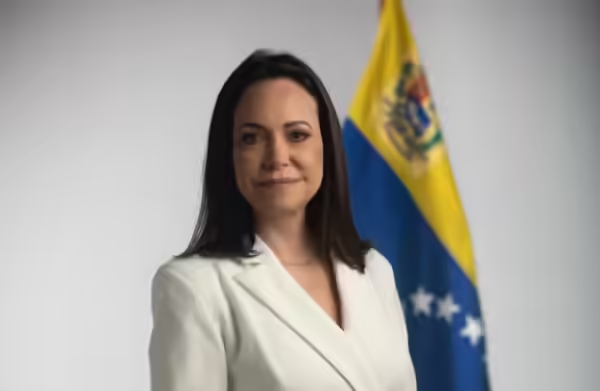
Over the years, she has been known for several things, which includes:
- Advocating free and fair elections
- Challenging authoritarian governance
- Calling for peaceful democratic transition
- Facing political bans, threats, and exile risks
Her leadership gained renewed global attention during Venezuela’s most recent election crisis, where she emerged as a unifying figure for opposition forces despite being barred from running herself.
Background on Machado’s political career can be found on Reuters and BBC
Why María Machado Won the 2025 Nobel Peace Prize
It really is a no brainer that Machado won the prize. According to the Norwegian Nobel Committee, the 2025 Nobel Peace Prize was awarded to María Corina Machado for her “consistent and non-violent efforts to advance democratic rights and political freedom in Venezuela under authoritarian rule.”
The committee cited her role in:
- Mobilising democratic opposition through peaceful means
- Advocating political reform without armed conflict
- Drawing international attention to human rights concerns
- Promoting dialogue despite political repression
Due to security concerns, Machado was unable to attend the Nobel ceremony in Oslo. Her daughter accepted the award on her behalf, a moment that underscored the personal cost of political activism in Venezuela.
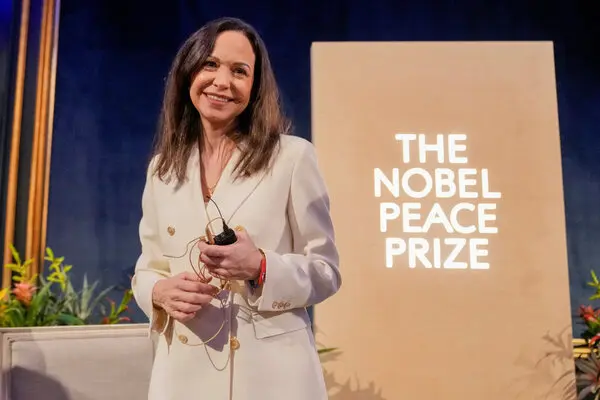
Official Nobel announcements can be referenced at the Nobel Prize site
2025 Nobel Peace Prize and the Donald Trump Connection
Shortly after the award ceremony, María Corina Machado met with former U.S. President Donald Trump, where she symbolically presented him with her Nobel Peace Prize medal.
This gesture sparked widespread confusion online, with some headlines wrongly implying that Trump had “received” or “won” the prize. The Norwegian Nobel Institute quickly clarified that Nobel Peace Prizes are non-transferable, meaning Machado remains the sole and official laureate.
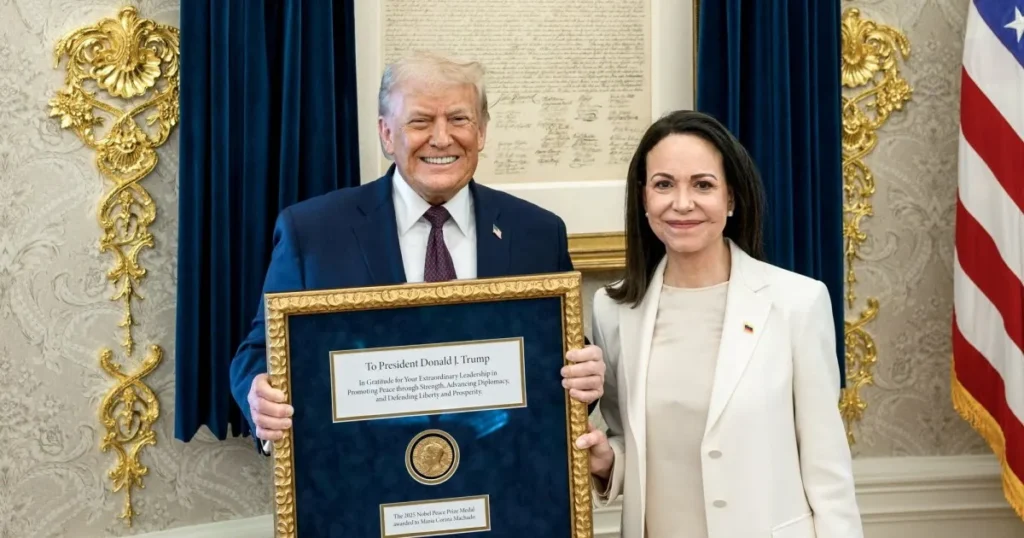
The medal presentation was described as symbolic, reflecting gratitude for U.S. support of Venezuela’s opposition during Trump’s presidency.
Clarifications were reported here
Public Reaction to the 2025 Nobel Peace Prize Moment
Global reactions were sharply divided concerning the 2025 nobel peace prize.
Supporters of Machado viewed the medal gesture as diplomatic symbolism rather than a political endorsement. Critics argued that it risked overshadowing the significance of her Nobel recognition or confusing public understanding of the award.
Media analysts noted how quickly symbolic acts can be misinterpreted in a digital environment where images circulate faster than context.
Why the 2025 Nobel Peace Prize Story Matters
The story of the 2025 Nobel Peace Prize highlights several modern realities:
- The global impact of symbolic political gestures
- The power and risk of viral moments
- The difficulty of separating recognition from interpretation
- The ongoing international focus on Venezuela’s political future
Above all, it reinforces the Nobel Committee’s emphasis on peaceful democratic advocacy, even under intense political pressure.
Understanding Venezuela’s Political Context
Venezuela remains deeply divided following years of disputed elections, economic instability, and international sanctions. Leadership legitimacy is not a theoretical debate, it affects daily life for millions of citizens.
Because of this context, Machado’s Nobel Peace Prize is viewed by supporters as international validation of Venezuela’s democratic struggle, rather than a simple political accolade.
Conclusion
The 2025 Nobel Peace Prize was officially awarded to María Corina Machado, recognising her commitment to peaceful democratic reform in Venezuela. While her symbolic gesture toward Donald Trump sparked global debate, it did not change the core fact: Machado remains the sole and recognised Nobel Peace Prize laureate.
In a world shaped by fast-moving narratives and powerful imagery, this moment serves as a reminder that context matters, and that behind every headline lies a deeper story worth understanding.
Enjoyed This Article?
If you found this breakdown of the 2025 Nobel Peace Prize insightful, feel free to share your thoughts in the comments.
Follow our blog for verified global news, political analysis, and context-driven reporting. You can also connect with us on Instagram, Facebook, X (Twitter), and LinkedIn for timely updates and stories that go beyond the headlines.
SHARE: